JXH Journal / Notebooks & Journals
Types of Notebooks and When to Choose Each
A field technician who writes standing up needs a different notebook from a student who hands in a sheet at the end of class. Start with where people write and what happens to the pages afterward. Those two details tell you more about the right format than a name like “business journal.”
Updated
Match the notebook to the work
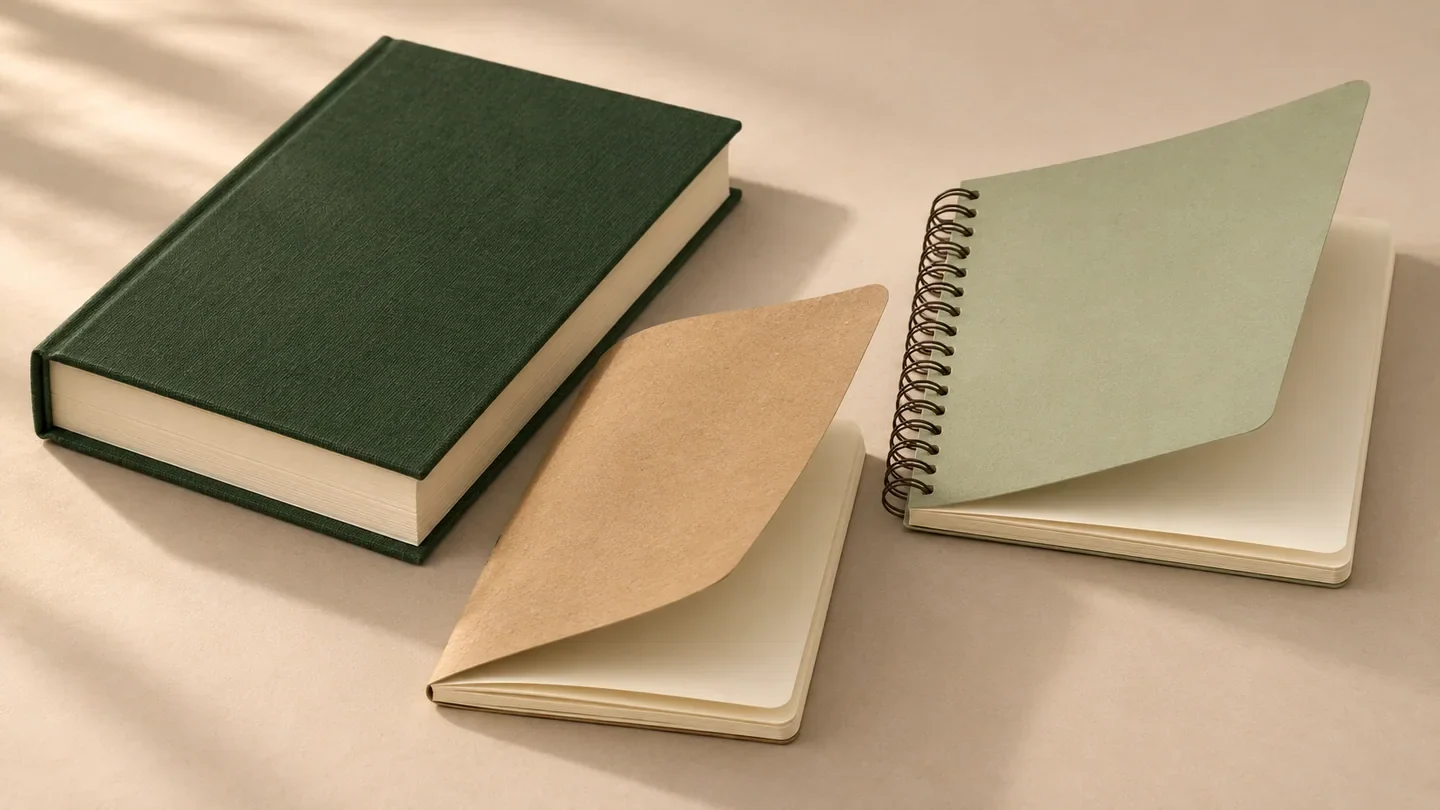
Notebook names describe different things. Hardcover describes the cover. Spiral describes the binding. Planner describes the content. A single notebook can be all three. Separate those choices when you compare samples. 3
| Type | Where it earns its place | What to try on a sample |
|---|---|---|
| Hardcover journal | Meeting notes or a reference log that stays together over time | Write a full line with the open book balanced on your hand. Check the support on both sides of the spread. |
| Softcover notebook | A travel journal or a slim book slipped into a conference packet | Put the closed book in the actual packet. Check how the corners and cover handle insertion. |
| Spiral or twin-wire workbook | A training session with a small desk or a shared work surface | Fold the cover behind the page and write near the binding with the hand you normally use. |
| Composition book | A course or project where readers need notes to stay in sequence | Check for sewn binding and unperforated pages if the entries need to stay in order. |
| Pocket memo book | Short observations on a shop floor or a site visit | Take it out of the intended pocket with one hand, open it and record a typical entry. |
| Planner or guided notebook | Repeat work such as weekly reviews, inspections or shift handoffs | Complete one real entry on a sample spread. Look for boxes that fill too soon or prompts that go unused. |
Hardcover or softcover for the same project?
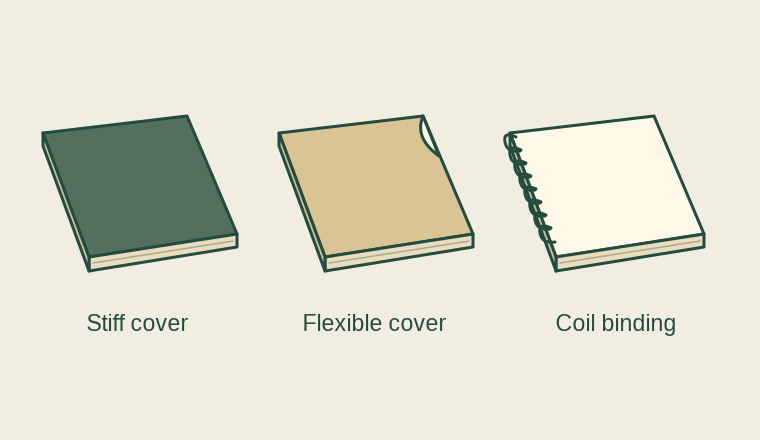
A rigid cover gives the writer something to lean on away from a desk. A flexible cover can bend to fit a crowded bag. Compare books with similar page counts and paper before attributing a difference in weight or thickness to the cover alone.
For an employee welcome kit, try both in the finished packaging with the pen and other inserts in place. A board cover that feels right in a meeting may keep a mailer from closing. A slimmer book can solve the fit problem, provided the recipient can still write comfortably. If a flat opening matters, ask how the pages are attached inside the cover. A hardcover can house a sewn or adhesive-bound book block. 1
Decide whether pages should come out
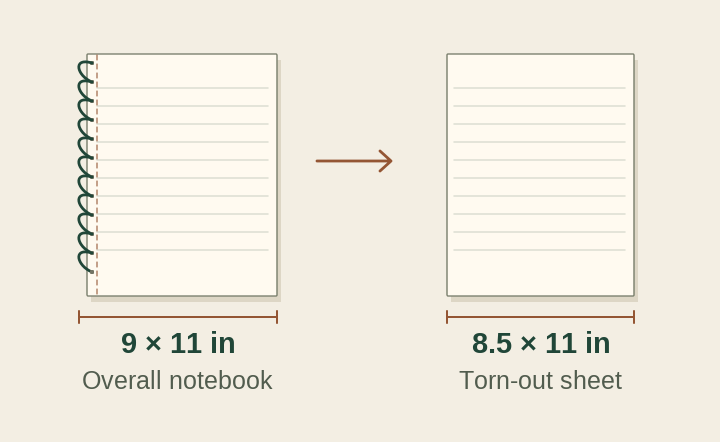
Students turning in assignments and workshop participants sharing sketches need a clean tear. A coil lets a page rotate, while a perforation gives it a tear line. Specify both features if you need both. Measure the usable sheet after removal if it must fit a binder or keep a preprinted form intact. For example, Mead lists a 9 × 11-inch spiral notebook with an 8.5 × 11-inch tear-out sheet. 4 In a bound log, an intact record may matter more than the ability to detach a page.
A composition book is one starting point for a record that should stay intact. For example, Mead specifies sewn binding and unperforated sheets for its Primary Composition Book. That combination belongs to that model. Check the construction and ruling of the book you intend to order. 2
Give the buyer and the designer the same brief
For a training workbook, a useful instruction might read: “Attendees write on a narrow desk, tear out one action sheet and keep the rest. Keep the full exercise on the detachable side of the tear line. Dimension the detached sheet on the proof.” That tells the designer where to end the exercise and tells the buyer what to check.
Record the closed size, cover stiffness, binding edge, page count, ruling and any tear-out sections. Include the actual pen or a typical writing instrument in the sample review. If suppliers quote in sheets and your design file uses pages, reconcile the counts: one leaf has two page faces. State separately whether a divider, cover or endpaper counts toward the writing space.
