JXH Journal / Notebooks & Journals
Notebook Binding Types and How They Open
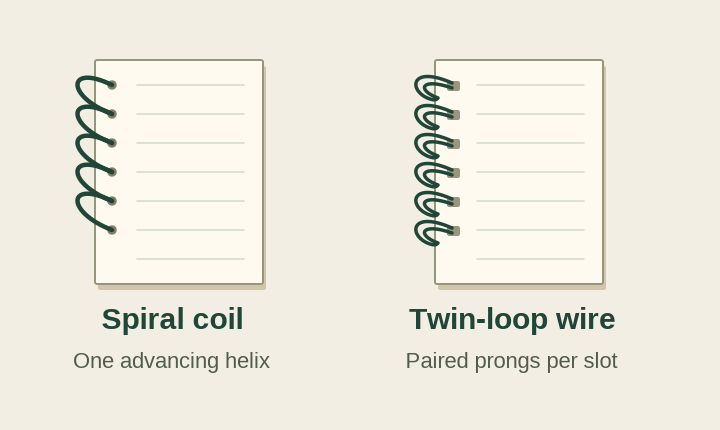
Look at the spine of an open notebook. A continuous coil threads through punched holes. Twin-wire binding uses pairs of loops. Open a sewn notebook to the middle of a section and you may see thread in the fold. In a perfect-bound book, adhesive holds the pages at the spine. Each construction changes where a hand can rest and how much of the spread a reader can use. [1]
Updated

Identify what actually holds the pages
A signature is a group of pages formed by folding a printed sheet. A book block is the assembled stack of pages inside the cover. Those two terms help you ask a supplier whether the block is sewn in sections or held together with adhesive. 1 4
| Binding | What you can see or confirm | Where to try it |
|---|---|---|
| Spiral (coil) | A single helix threads through punched holes along one edge. The coil can be plastic or wire. | Fold a training workbook back on itself. Check how easily the pages turn and where the coil meets the writer’s wrist. |
| Wire-O (twin-loop wire) | Pairs of wire loops close through a row of holes. This hardware looks different from a continuous spiral. | Lay a planner open to a weekly spread. Turn from Monday to the next week and watch for pages catching at the wire closure. |
| Section-sewn | Thread passes through the folds of signatures and joins the sections. The finished spine may also use adhesive. | Try the first, middle and last spreads in a journal that readers will write in from cover to cover. |
| Perfect bound | Adhesive holds the prepared spine of the book block. A typical paperback has a flexible cover wrapped around the glued spine. | Place instructions near the bound edge on a test spread. See how much the reader can see without forcing the book open. |
Where hardcover binding fits
A case-bound notebook has a separately made cover, or case, attached to the book block. The block inside can be sewn or adhesive-bound. For a hardcover journal, ask the printer to describe both the case and the method used to hold the pages. A closed-book photo may show the cover material and shape. Ask for the book-block specification or inspect a bound sample to identify what holds the pages. 1 4
If you need a spine wide enough for a title, obtain the cover template for your chosen page count and stock. For a wire-bound project, ask whether the wire will be exposed or concealed. A spine panel to print on and hardware that lets pages turn are separate design requests. 2
Specify what “lay-flat” means at the desk
A spread that stays open hands-free and a cover that folds behind the book solve different problems. The first helps a cook read a recipe at a counter. The second helps a trainee write on a chair with a small tablet arm. Either request is clearer when it describes the activity.
Use a sample at the intended page count and trim size. Open it near the front, halfway through and near the back. Let go of the book and see whether the spread stays open. Then write a line beside the gutter on each side. For a two-page diagram, check whether a reader can follow the line across the center. For single-page use, try folding back the cover only if the construction is intended to do so. Record the result on the sample you approve.
Leave room for the punch before artwork approval
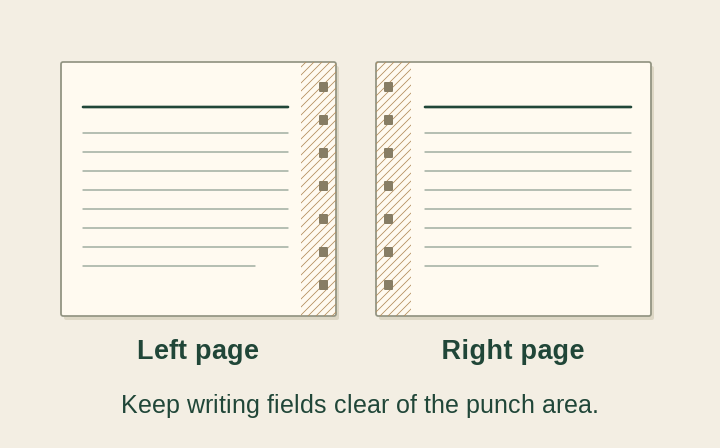
The inside margin of a wire-bound page must clear its holes. The SAIC Service Bureau illustrates this with a gutter zone on a sample page. Its measurements belong to its equipment. Request the actual punch layout from the supplier handling your job. 3
For a side-bound bilingual workbook, put a long translated heading and a response line on facing pages in the proof. Overlay the punch layout on both left and right pages. If a hole cuts off the end of the answer line, move the field before signing off. For a tear-out sheet, check the punch row, perforation and printed field together.
A useful inquiry names the binding edge, hardware or book-block construction, cover style, paper and page count. Attach the spread that is hardest to use. The person preparing the sample can then test the same opening behavior your readers need.