JXH Journal / Notebooks & Journals
Types of Notebook Paper and How to Test Them
A dot grid tells you how a page is ruled. It tells you little about what will happen when someone writes over the dots. Order notebook paper in two steps: choose the sheet that works with the writing instrument, then choose a layout that gives the reader enough room.
Updated
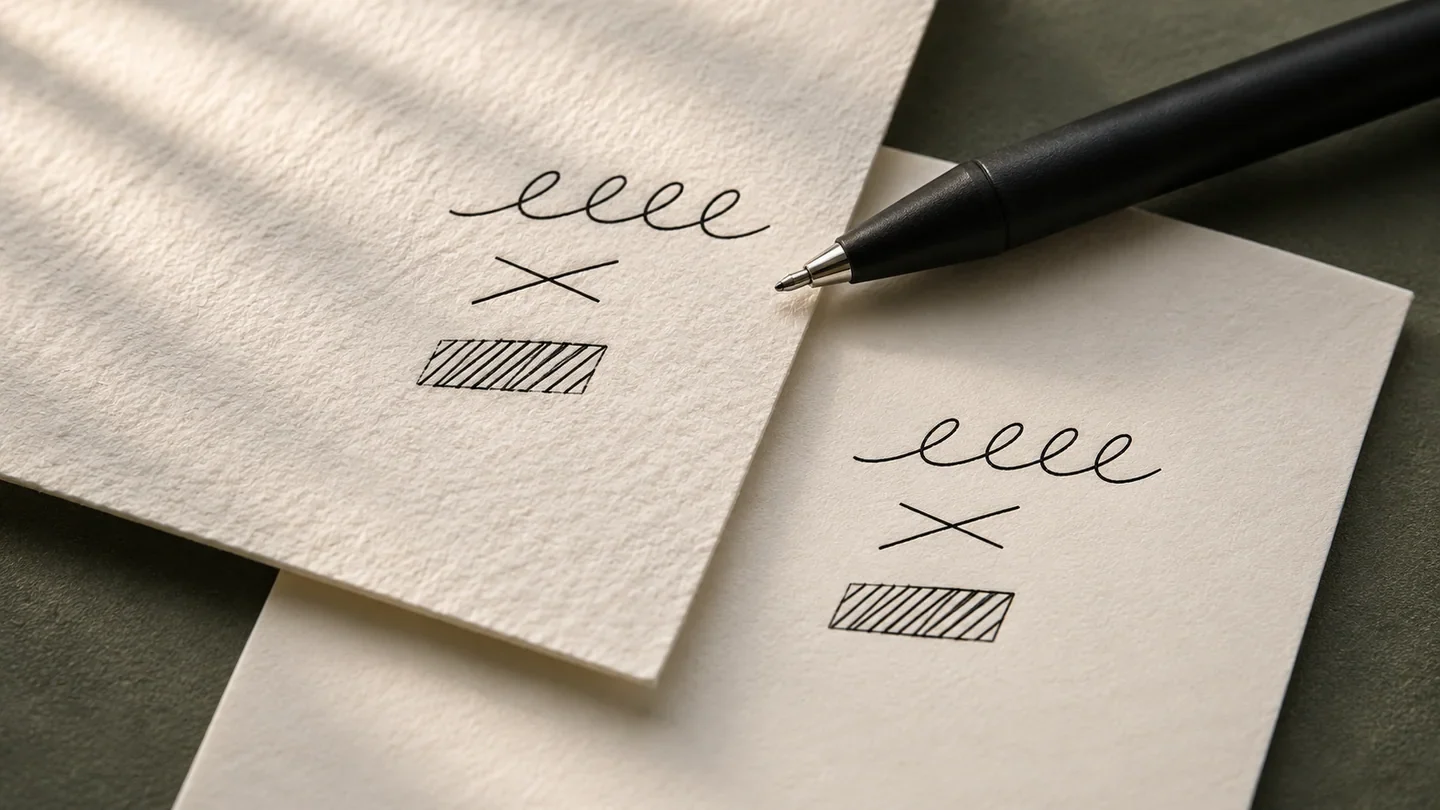
Pick the sheet with the writing instrument in mind
For everyday notes, start with a sample of smooth, uncoated writing paper. Try the ballpoint or gel pen that will ship with the notebook. Write at normal speed, then close the book as a user would. Open it again and look for a reversed ink mark on the facing page. If it leaves a mark, repeat the test with a longer drying interval. Keep the pen and paper the same.
For a sketch journal, compare a smooth writing sheet with a drawing sheet that has some tooth, the slight texture you feel under a pencil. Use the same pencil to shade a small square on each sheet, then erase half of each square. Strathmore illustrates how a graphite pencil produces different marks on smooth and textured surfaces. 1
Recycled content describes the source of some or all of the fiber. A buyer can request a recycled writing sheet or a recycled drawing sheet and still needs to specify the surface and intended use. If a percentage must appear on a printed cover, request documentation for the exact stock before approving that claim. 6
Choose the ruling after you try the sheet
Ruling is the pattern printed on the page. Rhodia’s guide illustrates plain, dot-grid, squared and lined layouts. The spacing and strength of the printed lines are design choices, so review an actual-size proof. 2
| Layout | A useful starting point for | Ask the designer to show |
|---|---|---|
| Ruled | Meeting notes and longer passages | Line spacing, margins and how many usable lines fit after the header. |
| Blank | Sketches, diagrams and freehand notes | The page at actual trim size, including any logo or footer that takes drawing space. |
| Graph or square grid | Measurements, layouts and calculations | One dimensioned square and the boundaries of the usable grid. |
| Dot grid | A mix of prose, quick tables and sketches | Dot spacing and darkness on the intended stock. Dots should remain visible beside pencil marks. |
Read the front, the back and the facing page
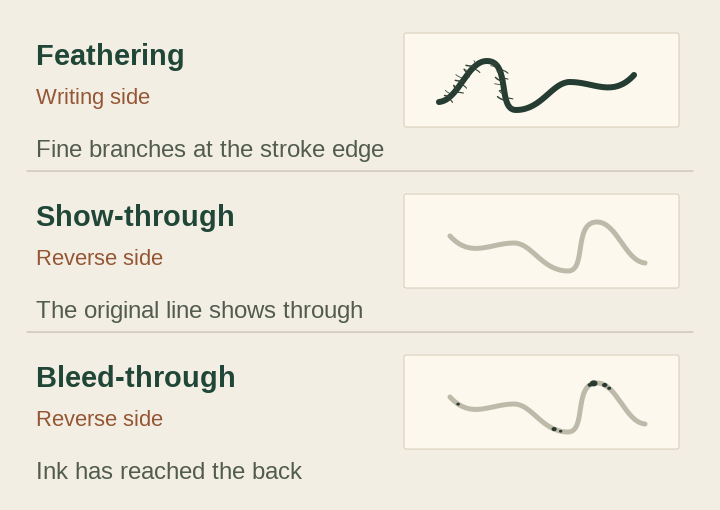
Show-through, also called ghosting, is writing visible from the reverse side even though the ink has stayed on the writing surface. Turn the sheet over and look at it flat on the rest of the pad in normal reading light. A visible shadow may be acceptable for one-sided sketches and distracting on a two-sided weekly planner.
Bleed-through means the ink actually penetrated to the reverse surface. Watch for tiny ink spots where the writer paused or crossed a line. Feathering happens at the edges of the stroke on the writing side: thin branches spread into the surrounding paper. A page can show one problem without showing the others. 3
What GSM can tell you
Grams per square meter (GSM) measures mass per unit area. Thickness, also called caliper, is a separate measurement. ISO describes separate methods for measuring these properties. Two stocks at the same GSM can differ in thickness, surface feel and how a particular ink behaves. 3 4 5
If you change stock but want a journal to fit the same sleeve, retain the intended page count and ask for a bound sample. A single loose sheet helps you judge writing feel. The assembled book shows how the sheets, covers and binding fit together.
Keep a sample record both parties can use
Label each sample with the stock reference, ruling, pen and ink. Use the same line of handwriting, crossed strokes and shaded patch on each. Include the wettest pen the intended reader actually uses. After the ink dries, write a second line on the reverse and see whether both entries are still easy to read.
For a two-sided planner, an approval note could read: “Both entries legible on the supplied paper with the enclosed black gel pen. Retain this marked spread with the approved sample.” Describe a failure by where it appears. A note about ink reaching the back gives the supplier a different problem to solve than a note about lines that look too dark.
